New features in ggOceanMaps version 3
Mikko Vihtakari (Institute of Marine Research)
22 June, 2026
Source:vignettes/new-features-v3.Rmd
new-features-v3.RmdDocumentation for users and AI assistants
Version 3 expands and reorganises the documentation for both users
and AI assistants. The repository includes AGENTS.md,
CLAUDE.md, and a memory/ folder with
package-specific guidance.
These files describe the projection rules, the
shapefiles contract, transform_coord(), common
pitfalls, and the package development workflow. The documentation site
now uses a short user manual that links
to focused articles.
When asking an AI assistant for help with ggOceanMaps, point it to https://github.com/MikkoVihtakari/ggOceanMaps/ so it can read the current package guidance.
Everything below is new or substantially improved in version 3.
High-resolution maps of European coast
The new wcs_bathymetry() function downloads EMODnet bathymetry
(~115 m resolution) directly from its Web Coverage Service. Select the
source through bathy.style; ggOceanMaps fetches, caches,
and renders the tiles for the map extent.
Two sources are available:
-
EMODnet (~115 m, European waters) —
bathy.style = "wemb"(blues) or"wemg"(greys). -
ETOPO1 from NOAA NCEI (~1.85 km, global) —
bathy.style = "wceb"or"wceg". Use this when EMODnet has no coverage for your region.
Coupled with the detailed EEA land
shapes (shapefiles = "Europe"), this produces the
highest-resolution maps ggOceanMaps has generated so far. Being able to
plot Norwegian fjords with this level of detail is a significant
improvement and has been a popular feature request. With v3, it is
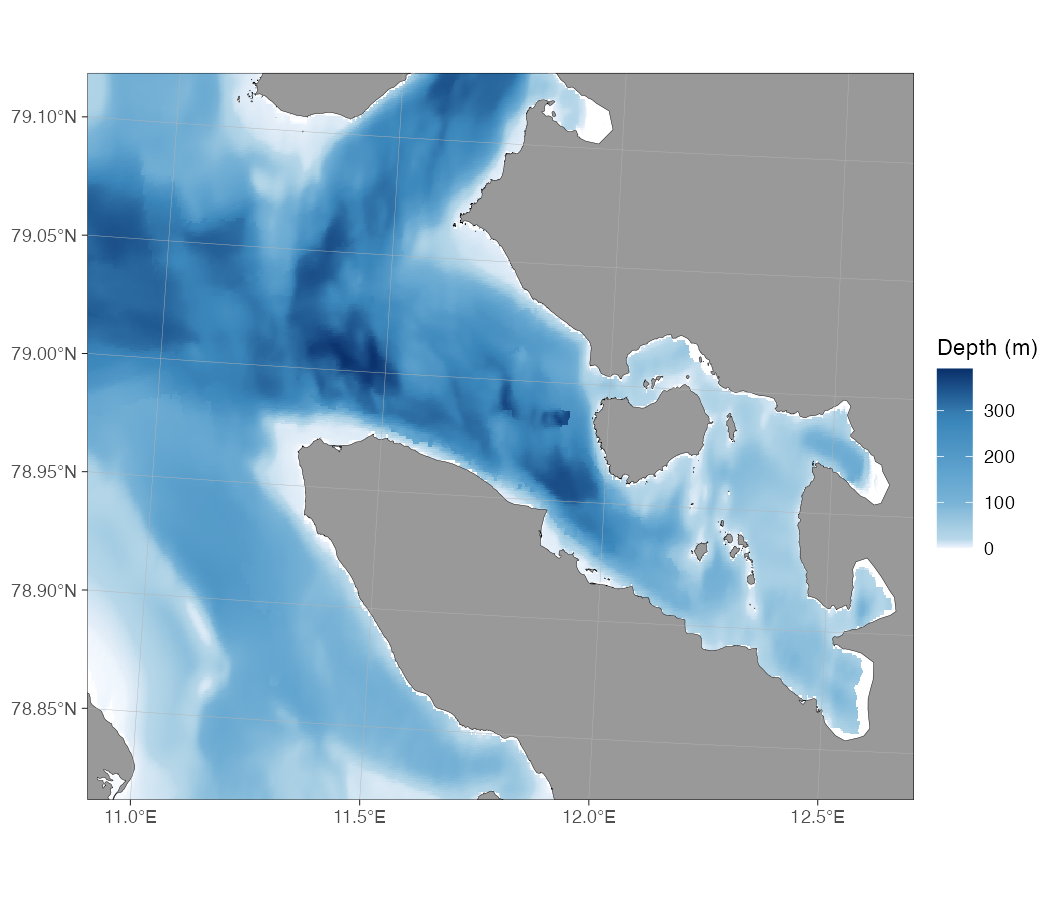
possible. Here is Kongsfjorden in Svalbard, drawn over the detailed
Svalbard land shapes:
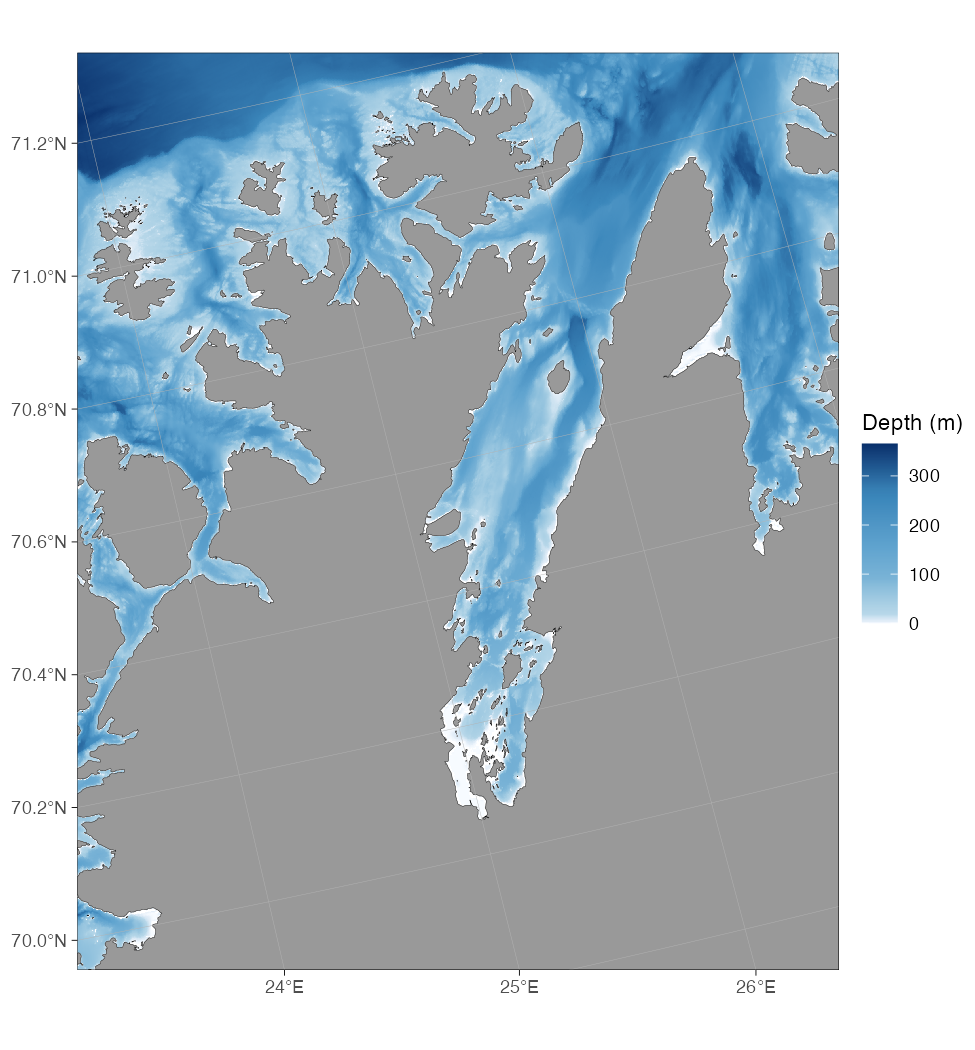
And Porsangerfjorden on the Finnmark coast of mainland Norway, with
the EEA "Europe" land shapes:
Note that the routine works everywhere in European waters, not just
Norway. The downloaded tiles are cached under
getOption("ggOceanMaps.datapath"), so re-rendering the
exact same map does not re-download anything. Do keep an eye on the size
of that folder, though — high-resolution tiles can make it bloat up
quickly. Bounding boxes outside a source’s coverage fail cleanly with a
pointer to the right alternative, and large areas are tiled and
mosaicked automatically. See the Bathymetry
article for the full list of sources and more examples.
Build your own shapefiles
The create-your-own-bathymetry workflow is now complete.
raster_bathymetry() turns a GEBCO/ETOPO/IBCAO grid into a
bathyRaster, and two vectorisers consume
it: vector_bathymetry() for depth-contour polygons (as
before) and the new vector_land() for a matching land
polygon extracted from the same grid.
rb <- raster_bathymetry(
  bathy = "path/to/your/grid.nc",
  depths = c(50, 100, 200, 500, 1000),
  proj.out = 4326,
  boundary = c(-5, 10, 50, 60)
)

basemap(
  limits = c(-5, 10, 50, 60),
  shapefiles = list(
    land = vector_land(rb), # NEW in v3
    glacier = NULL,
    bathy = vector_bathymetry(rb)
  ),
  bathymetry = TRUE
)
Because land and bathymetry come from the same grid, their edges line
up. The Customising shapefiles
article walks through this pipeline, clip_shapefile(),
and reading Norwegian Geonorge depth data with
geonorge_bathymetry().
Expanded documentation
Version 3 splits the old single manual into a concise overview plus a set of focused articles:
- Bathymetry — every way to get bathymetry into a map, from the shipped low-resolution grid to on-demand WCS and your own rasters.
- Customising shapefiles — supplying your own land, glacier, and bathymetry layers.
-
Adding graphical
elements — ocean-current arrows (velocity quivers and
schematic “Figure 1” arrows) and pie charts on maps via
scatterpie::geom_scatterpie(). - Cookbook — short, copy-pasteable recipes.
Testing
Version 3 adds smoke tests based on the historical regression corpus
and vdiffr SVG snapshot tests for visual changes. These
tests will be expanded in future releases with issues getting solved
over time.
Upgrading from version 2
Version 3 is backwards compatible with version 2 map code; existing
basemap() and qmap() calls keep working. If
you used the older bathymetry styles, see the version 2 release notes and the Bathymetry article for the current
bathy.style names.